
The Long Journey of the World’s Greatest Card Game


Choose a language
 Français
 Deutsch
 Español
 Italiano
 Português
 Nederlands
 Русский
 中文
中文
 Türkçe
 Dansk
Dansk
 Svenska
 Norsk
Norsk
 हिन्दी
The Ancient Roots
Whist and the Trick-Taking Tradition
To truly understand bridge, we need to travel back several centuries, long before the game itself took shape. Bridge belongs to a family of trick-taking games that date as far back as the early 1500s in England, where early versions of whist were played under names like triumph, ruff, trump, slam, and whisk.
By the mid-17th century, the game had settled under the name whist, and in 1742, it gained widespread popularity thanks to Edmond Hoyle’s Short Treatise on Whist, one of the first bestselling rule books in gaming history.
Whist was played by four players in two partnerships, each receiving thirteen cards from a standard 52-card deck. The objective was simple: win as many tricks as possible. There was no bidding phase, no negotiation of contracts just pure card play. Elegant and strategic, yet lacking the layered complexity that defines bridge today. Still, it spread widely and became a cornerstone of card-playing culture.
The Mysterious Birth
Biritch and the Eastern Connection
The transition from whist to bridge is not entirely clear and remains one of the more intriguing chapters in card game history. The earliest documented version of bridge appears in 1886 under the name Biritch, or Russian Whist, described by John Collinson, an English financier. He later traced its origins to the Russian community in Constantinople.
The name biritch is believed to come from a Russian word referring to an announcer or official. Yet, a more romantic story suggests that British soldiers during the Crimean War may have invented the game, naming it after the Galata Bridge in Istanbul, which they crossed daily to play cards in nearby cafés.
Regardless of which story is true, the geographical thread is consistent. Variants of the game were played in Greece and Constantinople before spreading to the French Riviera in the 1870s. Historian Thierry Depaulis concluded that the game likely developed within diplomatic circles in Istanbul around the 1860s.
Importantly, Biritch already included many elements of modern bridge:
- A chosen trump suit
- The concept of “no trumps”
- A visible dummy hand
- Scoring above and below the line
- Bonuses for slams
In many ways, the skeleton of today’s bridge was already in place.
Bridge Whist
A Social Sensation
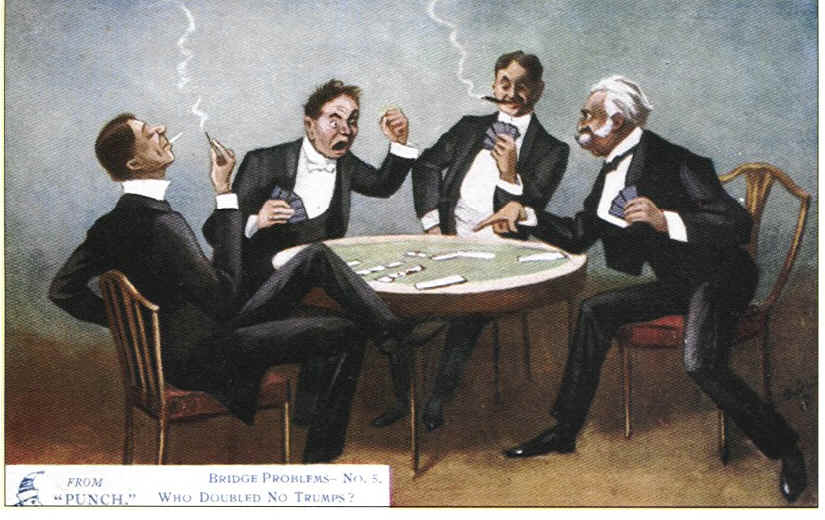
From Mediterranean cafés to elite clubs in London and New York, the game quickly gained popularity. By the 1890s, bridge was being played in prestigious venues, and even traditional whist players began to take notice.
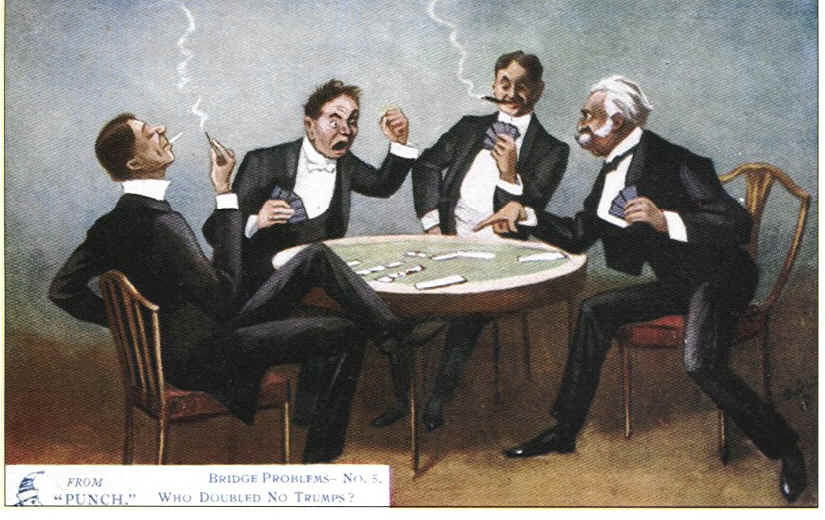
This version, known as bridge whist, became a true social phenomenon. For the first time, a card game from the whist family appealed equally to men and women. It moved beyond gentlemen’s clubs and into drawing rooms, becoming a fashionable pastime among high society in both Europe and America.
Bridge whist wasn’t just a game—it was a social activity that reshaped how people gathered and interacted.
Auction Bridge
The Bidding Revolution
Despite its popularity, bridge whist lacked one crucial element: competition during the setup of the hand. The trump suit was simply chosen, leaving little room for strategic contest.
This changed in the early 1900s with the introduction of auction bridge. Players could now bid against each other to determine the contract and the trump suit. This added a dynamic layer of competition and strategy before the play even began.
The concept quickly spread. By 1907, London’s Portland Club had adopted auction bridge, and American clubs followed soon after. Within a few years, bridge whist had nearly disappeared.
The game had evolved into something far more sophisticated:
- Players evaluated their hands
- Communicated through bids
- Competed not only in play, but in strategy
Bridge had entered a new intellectual era.
Harold Vanderbilt and the Birth of Contract Bridge
Although auction bridge was a major step forward, it still had flaws particularly in how scoring rewarded players regardless of how ambitious their bids were.
Everything changed in 1925, when Harold Stirling Vanderbilt introduced contract bridge. Drawing inspiration from earlier variations, he redesigned the scoring system and introduced the concept of vulnerability, fundamentally improving the balance of the game.
His key innovation was simple but profound:
Only the tricks promised in the bid would count toward scoring bonuses.
This meant that:
- Bidding became far more meaningful
- Risk and reward were properly aligned
- Strategy became deeper and more precise
Contract bridge quickly spread across the United States and became the dominant form of the game. Soon, the word “bridge” itself became synonymous with this new version.
The Golden Age
Celebrity, Rivalry, and Radio
During the 1930s, bridge reached extraordinary levels of popularity. Major matches attracted public attention, and top players became well-known figures.
Ely Culbertson emerged as one of the most influential personalities, leading high-profile international matches and publishing bestselling books on the game. Bridge matches were even broadcast on the radio, turning the game into a spectator experience.
Instruction, strategy, and competition flourished. Bridge was no longer just a pastime—it was a cultural phenomenon.
Duplicate Bridge
Removing the Luck
One criticism of traditional bridge was the role of luck in card distribution. Duplicate bridge was developed to address this.
In duplicate play:
- The same hands are played at multiple tables
- Results are compared across players
- Skill becomes the primary differentiator
Luck is not eliminated but it is neutralized. Every player faces the same cards, making performance the true measure of success.
The establishment of the World Bridge Federation in 1958 helped formalize competitive play, and events like the Bermuda Bowl elevated bridge to a global competitive level.
Bridge Around the World
Over time, bridge became one of the most international games ever created. It is played across continents, cultures, and generations.
Countries like Iceland, Brazil, Turkey, Israel, Norway, and the Netherlands have all embraced the game in unique ways. In some places, it is even taught in schools.
Bridge has also attracted notable enthusiasts, including investors, political leaders, and actors demonstrating its wide appeal beyond traditional gaming circles.
Bridge Today
A Game Reinvented Online
The late 20th century brought challenges. With the rise of television, video games, and digital entertainment, fewer young players were drawn to bridge. In many countries, the player base began to age.
But technology also provided new opportunities. Online platforms such as Bridge Base Online made it possible to play anytime, anywhere.
The COVID-19 pandemic accelerated this shift dramatically, pushing tournaments and casual play online. New platforms like RealBridge introduced video and audio, recreating the social feel of in-person play. Meanwhile, AI-powered bridge programs reached impressive levels of strength.
Today, bridge is both traditional and modern:
- Played in clubs and online
- Social and competitive
- Local and global
What Bridge Is, at Its Heart
After five centuries of evolution from whist in Tudor England, through the smoky coffeehouses of Ottoman Istanbul, the glittering salons of the French Riviera, the grand clubs of New York and London, the radio broadcasts of the Depression era, the Italian Blue Team’s decade of dominance, and now the screens of millions of players around the world bridge remains at its core what it always was: a partnership game demanding memory, inference, communication, and courage.
It combines mental stimulation, luck, and socializing in ways that are hard to find in other games so cheap and easy to play. With over 25 million players worldwide, bridge stands as one of the most intellectually satisfying pastimes anyone can pursue. The deck is the same 52 cards it has always been. The table still seats four. Two still sit across from each other as partners, bound by trust and the language of the bid. Whatever technology changes around it, that structure intimate, competitive, deeply human, seems unlikely to go away.



Responses